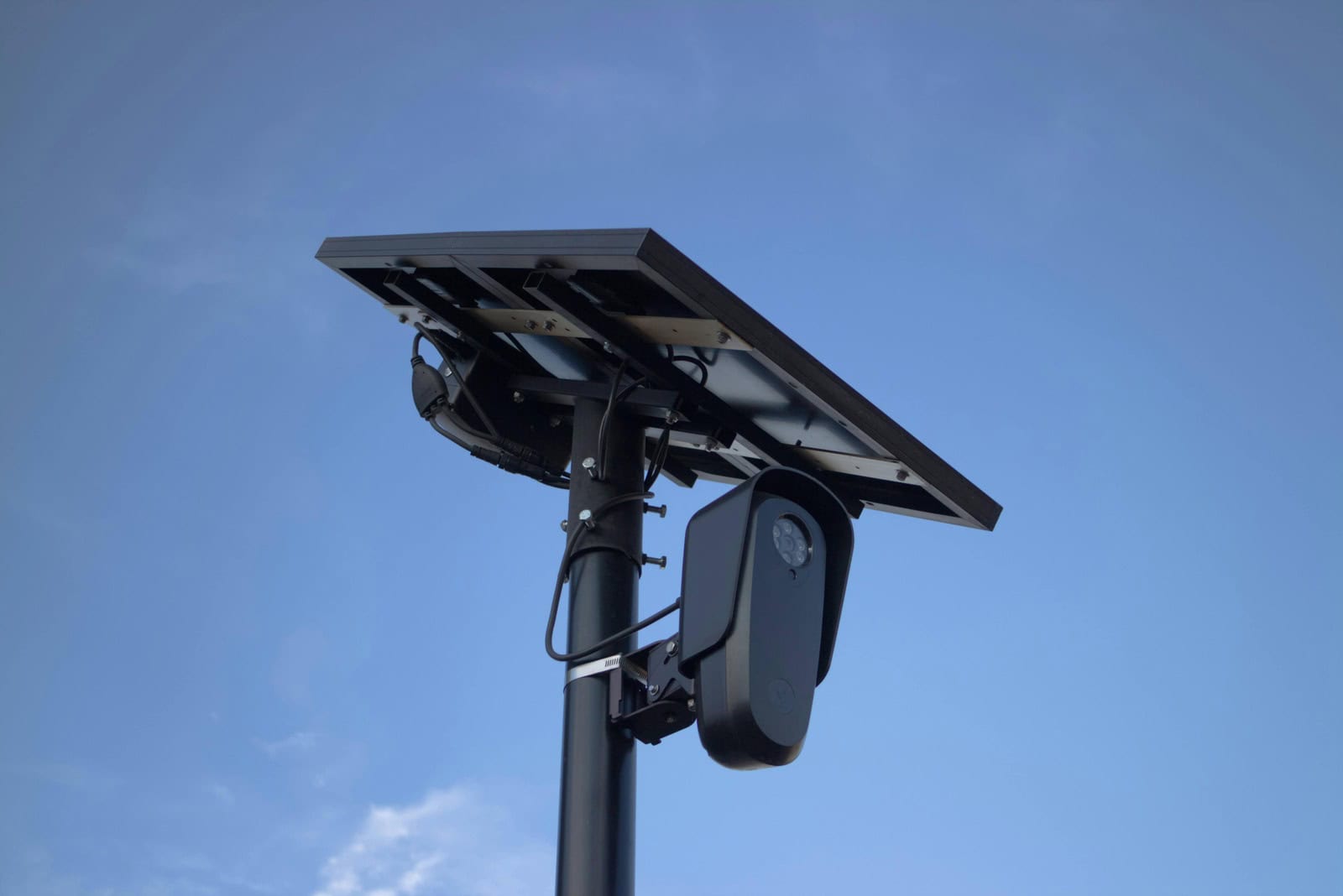

Who’s watching you?
And this is just the Cape Fear. Statewide, volunteers have mapped roughly 2,819 ALPR cameras across North Carolina — about 85% of them Flock — and the plate readers are only the base layer. Bolted on top: police drone programs, pan-tilt-zoom (PTZ) cameras that follow people in real time, and Fusus-style networks that fold in thousands of private cameras — one North Carolina sheriff’s map alone reaches 2,147 cameras. See the statewide map →
And it doesn’t stop at the county line. About 3,904 agencies nationwide can search these cameras. Roughly 90% of the searches run against North Carolina’s cameras came from outside the state — and the agencies here redact the name of every agency that searched. See who’s searching →
Why are they watching you?
The system logs everyone, regardless of wrongdoing. You did nothing wrong. It tracks you anyway.
Marketed as crime-fighting — yet independent research hasn’t shown these networks reduce crime, and police already have warrant-based tools for real cases.
Once collected, the data is searched, shared across state lines, and reaches the federal government. Against North Carolina cameras, at least 2,698 immigration-labeled searches — civil, deportation-type — have already run, and the FBI alone ran 63,213 searches of one small coastal town’s four cameras. How the feds get in →
End Mass Surveillance in the Cape Fear & North Carolina
AI license-plate cameras log every driver across the Cape Fear — New Hanover, Brunswick, Pender, Columbus, Onslow, and the beach towns — with no warrant, no consent, and no way to opt out. You didn’t agree to be tracked. DeFlockILM hands you the plan to end it: sign, speak up, and hold your town or county to account.
Unanimous. 4–0.
Residents showed up — and the Board acted.
On September 8, the Commissioners voted 4-0 to cancel the county’s Flock contract. The county’s cameras are coming down. The work continues at the beach towns and neighboring counties — each runs its own cameras and must decide separately. Here’s where the public can be heard next.
“Those who would give up essential Liberty, to purchase a little temporary Safety, deserve neither Liberty nor Safety.”
Franklin wrote it in a tax dispute, not a debate about cameras — and we’d rather tell you that than have you learn it elsewhere. We keep it because the principle outlived the argument: a community that trades its liberty for the promise of a little safety usually ends up with less of both.
You did nothing wrong. They’re tracking you anyway.
Wilmington and New Hanover County have installed Flock cameras — Automated License Plate Readers (ALPRs) that photograph every passing vehicle and log its location, date, and time, along with your car’s make, model, color, and distinctive features like dents, roof racks, and bumper stickers.
This data is collected on drivers regardless of whether anyone is suspected of a crime. Marketed as crime-fighting tools, these cameras ignore the warrant-based methods police already have — and instead give the government the power to track all of us, all the time, without a judge.

No Warrant
Officers can pull your movement history without probable cause or a judge’s review.
No Consent
Your data is captured without your knowledge — and there is no way to opt out.
No Limits
A network of cameras builds a real-time “pattern of life” map of where you go.
Past 3,000. From about 1,200 in the spring to 4,217 today. 2,343 of them live in New Hanover County: the people the commissioners answer to.
What this technology really does
Two short videos on how ubiquitous ALPR surveillance works — and why it matters here.
The cost of doing nothing
Surveillance infrastructure, once installed, is rarely removed — and its uses only expand. Here’s what we lose if the grid stays.
- ✕The grid becomes permanent. Once cameras are normal, being tracked becomes normal too.
- ✕Your patterns of life are logged — where you worship, seek medical care, organize, and sleep — accessible without a warrant.
- ✕Your data travels. It can be shared with third parties, other states, and federal agencies — sometimes in violation of policy or law.
- ✕Innocent people get hurt. Misreads have led to wrongful arrests, cars wrongly flagged as stolen, and families held at gunpoint.
- ✕You pay for it. Taxpayers fund the very system that surveils them.
The honest case for the cameras — and where it breaks
We take the strongest arguments for Flock seriously. Here they are, stated fairly — each with the honest answer. We would rather lose a point than win it with a straw man.
“The cameras solve real crimes — they recover stolen cars, find missing people, and give police leads they couldn’t get otherwise.”
Some do, and we won’t pretend otherwise. But independent research hasn’t shown ALPR networks meaningfully reduce crime, and police already have warrant-based tools for real investigations. The question isn’t whether a camera is ever useful — it’s whether it should scan everyone, all the time, with no warrant. See the evidence on Flock’s claims →
“If you’ve done nothing wrong, you have nothing to hide.”
“Ultimately, saying that you don’t care about privacy because you have nothing to hide is no different from saying you don’t care about freedom of speech because you have nothing to say.”— Edward Snowden
And it is not hypothetical. Two North Carolina women — Jacqueline McNeill and Jasmine Horne — had nothing to hide and were handcuffed anyway when the system got it wrong. The data is collected on everyone regardless of suspicion, has been breached, and has been misused by officers to stalk. “Nothing to hide” assumes the system never fails and is never abused. It already has. The wrongful-arrest cases →
“There are policies that prevent misuse — Flock bans immigration searches and limits who can access the data.”
A written policy is not a warrant, and it isn’t enforceable oversight. Search logs from six NC agencies’ unredacted audits show at least 2,698 immigration-labeled searches ran anyway, and New Hanover County redacts the name of every agency that searched its cameras — but five neighboring agencies didn’t, and their logs reveal a nationwide network searched ~90% from out of state (how we counted). Policies change with whoever holds the keys. They denied it, then admitted it →
Three steps to take it back
Stopping mass surveillance sounds huge. It comes down to three things anyone can do this week.
Learn the facts
Read the talking points and the county’s own public records so you can speak with confidence.
Sign the petition
Add your name to the residents calling for Flock’s removal. It takes one minute.
Tell your leaders
Send a ready-to-edit email to your County Commissioners — and show up to a meeting.
Wondering if this is even winnable? See exactly how this ends →
Backed by the record. Grounded in the law.
DeFlockILM isn’t speculation. It’s built on public documents, Supreme Court precedent, and communities that already said no — including a county-by-county map of every ALPR camera in North Carolina.
See all 100 NC counties on the map →
The contract cost, the search counts, the camera counts, the retention limits, and where the petition’s signers actually live — each figure with its source, on one page built to be quoted.
Privacy, restored.
- ✓The cameras come down and the county cancels its Flock contract.
- ✓You drive freely — to the clinic, to church, to a meeting — with no record created.
- ✓Public safety respects the Constitution and requires a judge, not a database.
- ✓Wilmington becomes the community that recognized the line and refused to cross it.
Ready to reclaim your privacy?
One signature. One email. One meeting at a time.
Frequently Asked Questions
Is there a group fighting Flock cameras in Wilmington?
Yes — DeFlockILM is the citizen-led group working to remove Flock ALPR surveillance cameras from Wilmington and New Hanover County, NC. You’re on it.
Does New Hanover County use Flock cameras?
Yes. New Hanover County holds the Flock contract (#25-0364), which the Sheriff’s Office operates; records show its network was searched roughly 2.98 million times in ~16 months — and neighboring agencies’ logs show who is searching: mostly out-of-state police, with North Carolina’s data ending up under Texas and federal rules. See the records. · the numbers.
Can I opt out of being scanned?
No — every vehicle is logged, with no opt-out. What you can do is help get the cameras removed: sign the petition and email your leaders.
How do I take action in Wilmington?
On September 8, 2026 the Commissioners voted 4-0 to cancel the county’s Flock contract, after hours of public comment on Aug 17 in which dozens spoke and not one in favor. The work now moves to the beach towns and neighboring counties — see where to speak next, sign the petition, and watch what residents told them.
You’re not a suspect. So stop being tracked like one.
It takes one minute. Add your name — then tell the officials who represent you to take the cameras down.